Yes, this is about that competitor. The one you keep losing to.
You know the one.
They are not obviously better than you. Their product is not blowing yours out of the water. Their booth at CEDIA was fine. Their press coverage is comparable. On paper, every time you go head to head, it should be a coin flip.
And yet.
They keep showing up in deals you thought were yours. Dealers who used to spec you are quietly shifting their recommendations. You hear their name more than you used to. You cannot put your finger on why, and that is the most frustrating part — because you cannot fix something you cannot see.
Here is what I have come to believe after years in this industry: the gap is almost never the product. It is the reputation. And reputation is being built — or eroded — in conversations you are not part of.
The Conversation I Am Talking About
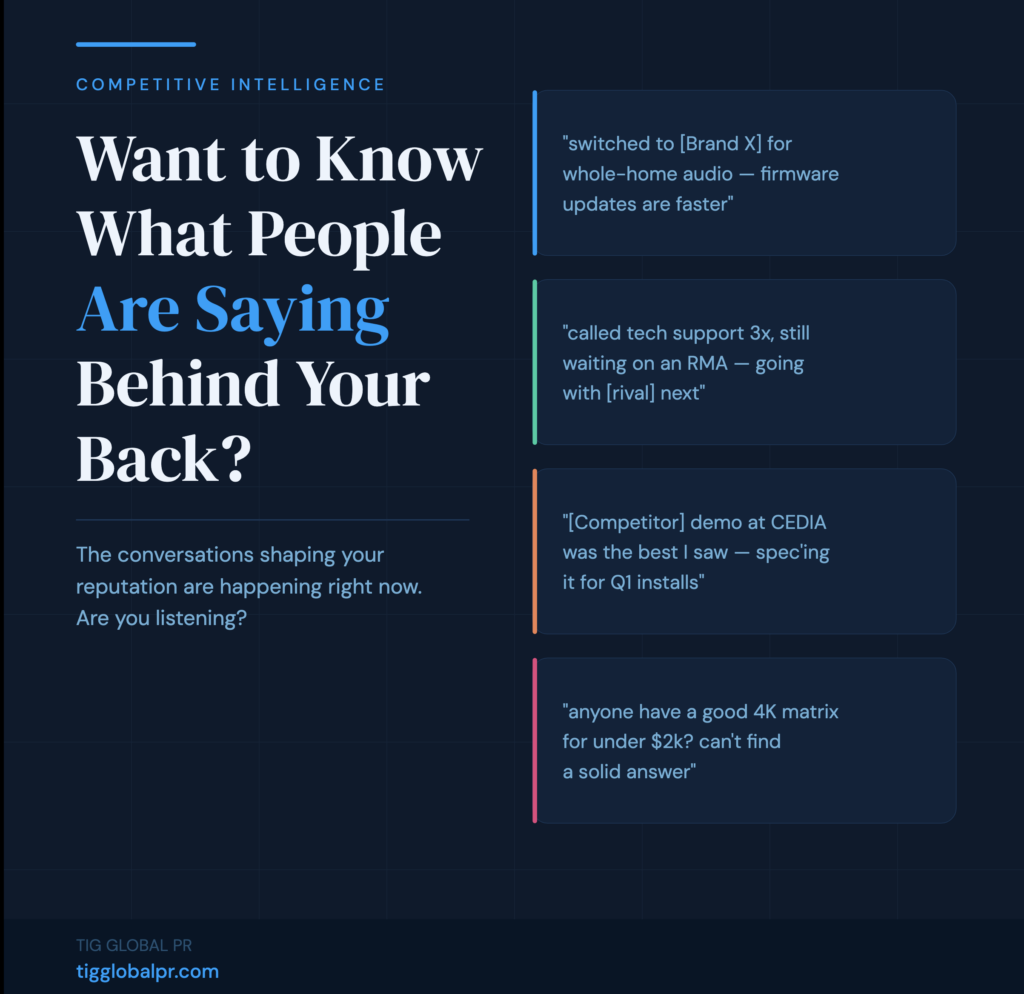
It is not happening in one place. It is happening in the Facebook groups where integrators swap recommendations at 9 p.m. on a Wednesday. In the Reddit threads where dealers compare notes on who actually picks up the phone when something goes wrong. In the comment sections under trade publication articles, in regional dealer forums, in the DMs that start with “hey, quick question — are you still using those guys?”
These conversations are honest in a way that almost nothing else in marketing is. Nobody is performing for a brand. Nobody is being careful. They are just talking to each other, sharing real experiences, making real recommendations, steering real deals.
And right now, today, your competitor is being talked about in those places. So are you. The question is whether you know what is being said — and whether that conversation is building your reputation or quietly chipping away at it.
What Social Listening Actually Is
I want to be direct here because this term gets thrown around loosely and I think it either scares people off or, worse, makes them think they already do it.
Checking your mentions is not social listening. Searching your brand name on Instagram once a week is not social listening. And the metrics most brands rely on — likes, clicks, impressions, engagement rates — tell you what already happened. They are a rearview mirror. By the time the data shows up in a report, the conversation that generated it has moved on.
Social listening is different because it is real time. It is monitoring the full conversation — your brand, your competitors, your product categories, the keywords your buyers actually use — across social platforms, forums, review sites, and industry publications, whether anyone tags you or not. It is the difference between waiting for someone to tell you what is being said and actually knowing, while it is still happening.
When I look at a social listening dashboard for a brand in this space, here is what I am actually seeing:
How your share of voice stacks up against your top competitors right now — not last quarter, right now. Whether sentiment around your brand is trending up or down and what is driving it. What integrators are saying about a competitor’s new product launch in the forums before that feedback surfaces anywhere official. What questions keep coming up in the communities your buyers live in — questions nobody is answering well, which is an open door if you want it.
And specifically, what is being said about your competitor that might explain why they keep showing up in deals you thought were yours.
The Trade Show Angle Nobody Talks About
Here is one I find particularly valuable and particularly underused.
You go to CEDIA. You do the show. You fly home. You write the recap.
The conversation does not end when you leave the floor. It picks up. Integrators who attended are posting about what they saw. Integrators who did not attend are asking what they missed. Dealers are tagging each other in content. The post-show conversation online is often more candid and more detailed than anything that happened on the floor itself — because people are no longer talking to brands, they are talking to each other.
What products are people still buzzing about two weeks later? What complaints keep surfacing about a competitor’s demo? What category is suddenly generating way more conversation than it was six months ago? What does the sentiment look like around your booth versus theirs?
That intelligence shapes your next move. Your next pitch. Your next product story. Your next show. Most brands never have access to it because they stop listening the moment they land at the airport.
Why I Care About This Enough to Write About It
Because I have watched too many good brands in this industry make critical decisions based on an incomplete picture.
They rely on the feedback from the same five dealers they have always talked to. Which is not nothing — those relationships matter enormously and I would never suggest otherwise. But five dealers, however trusted, are not the industry. They are five perspectives. And the reputation your brand has in the rooms those five dealers are not in is just as real and just as consequential as anything they are telling you directly.
The brands that are winning right now are not necessarily the ones with the biggest budgets or the best products. They are the ones who know what the full room is saying — not just the room they are already in — and use that knowledge to show up smarter, respond faster, and position themselves in exactly the gaps their competitors are leaving open.
Social listening does not replace relationships. It expands what you can see beyond them.
And when you cannot figure out why you keep losing to that one competitor, that expanded view is usually where the answer lives.
We now offer social listening as part of what we do at TIG — competitive monitoring, brand sentiment tracking, post-event analysis, and the ongoing intelligence that makes everything else sharper. If you want to know what the full conversation looks like for your brand right now, let’s talk.